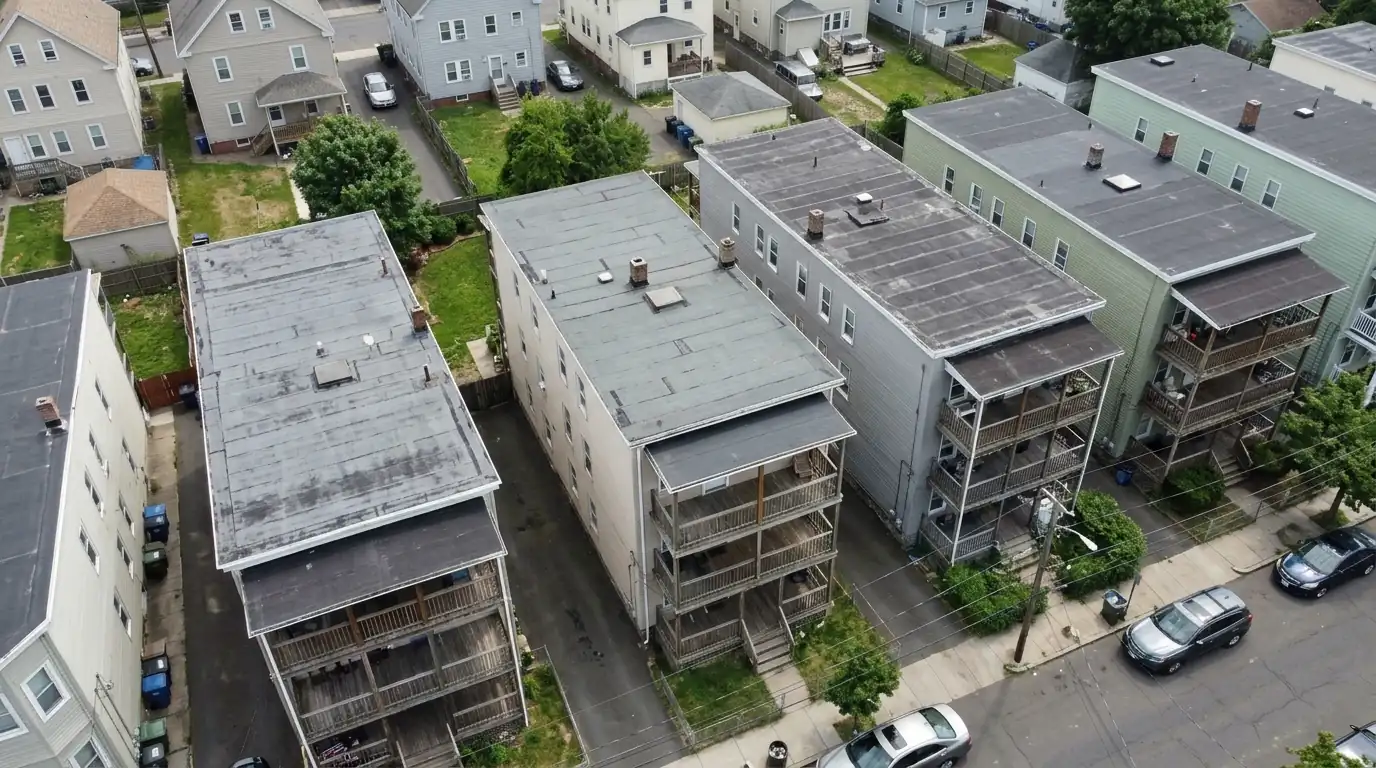
Most flat roofs on New Haven two- and three-families are rubber, modified bitumen or old tar and gravel. They usually fail at seams, edges and drains, and they need to pitch toward a drain or scupper. A replacement with tapered insulation stops ponding; a coating only helps a roof that is still dry underneath.
Why so many city roofs are flat
Triple-deckers and many two-families built in the late 1800s and early 1900s have a low-slope main roof hidden behind a cornice, with steeper gables on the front. Stacked porches add their own small roofs. From the street you may never see the part that leaks.
Where they fail
Flat roofs rarely fail in the middle. Leaks start where the membrane turns up a parapet or wall, at seams, around skylights and hatches, and at drains and scuppers that clog with leaves.
- Seams that have opened
- Membrane pulling away from walls
- Ponding water after rain
- Clogged drains or scuppers
- Blisters from trapped moisture
Which system to choose
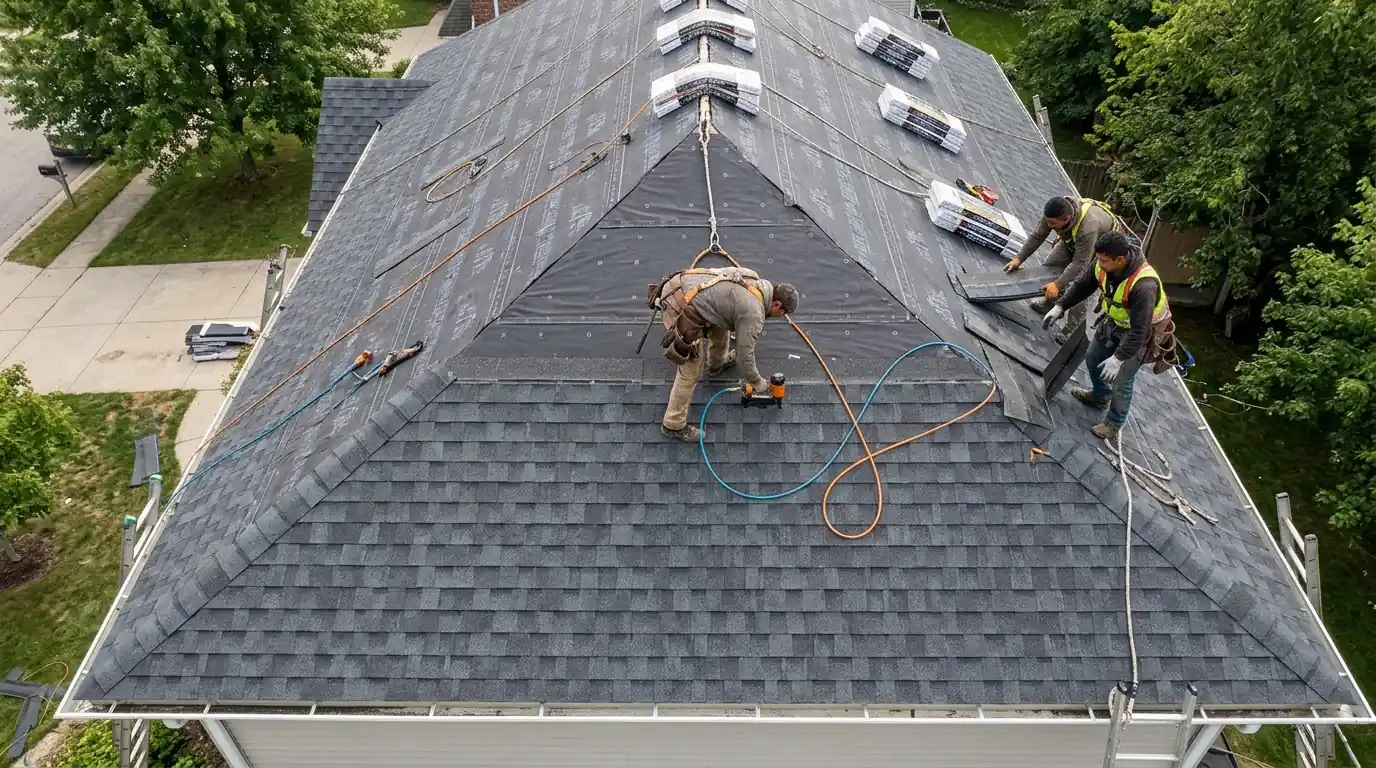
EPDM rubber is forgiving and easy to repair. TPO reflects summer heat and has welded seams. Self-adhered modified bitumen is tough under foot and avoids open flame on wood-framed buildings. Any of them works when the edges and drainage are done right.
Planning around tenants
Work is noisy for a day or two and may need access through a top-floor unit or hatch. We give owners a schedule to pass to tenants and keep the building weathertight at the end of every day.
Costs
Flat roof replacement on a triple-decker main roof often runs from the high single thousands into the teens, depending on size, insulation and parapet work. Porch roofs and pitched front sections are priced separately.
Questions readers ask
How long does a flat roof last on a triple-decker?
Rubber and TPO roofs often last 20 to 30 years; modified bitumen 15 to 25, with care.
Is a roof coating good for my three-family?
Only if a core sample shows dry insulation. Coating over wet material traps moisture.